Artly App - Mobile App Design

Problem: Artists want a platform to promote and monetize their work.
Solution: Our group’s mobile app is designed to cater to the artist-entrepreneur to increase their network, exposure, and recognition within the community while simultaneously monetizing their work online.
Team members: Tessa Sousa, Adriana Avila, Yash Sharma, Isabela Villanoy
Tools: Figma, Miro, Google Drive, Google Suite, Trello (Kanban board)
Role/s: UX Researcher, UX Designer, UX Content Designer
Discovery
Secondary Research
According to our secondary research from Forbes and the Financial Post, side hustles and small businesses boomed in Canada for three reasons: to create flexible work schedules, to augment financial gaps in their life, and to monetize from their passions. Another analysis can also be made: individuals are diversifying their income streams with the instability of working during the pandemic (unemployment and unstable longevity of career). In fact, e-commerce application Etsy has seen a 425% increase in Etsy shop openings in 2021, which reflects the entrepreneurial mindset that people have during unprecedented times.
“What the pandemic has really shined a light on is that we don’t have a lot of autonomy on how we work and where we work and when we work, and people are looking for more control.”
-- David Zweig, Associate Professor of Organizational Behaviour at the University of Toronto.
Interview Plan

Our group began by conducting 4 user interviews with a structured set of conversational questions to illicit organic responses. Our goal was to understand how the pandemic has impacted the art marketplace and gig economy and how users are responding to the rise of freelancing and side hustle culture. We discovered that individuals were interested in the side hustle culture because of financial and individual empowerment to have flexible work time, monetizing passions, and diversifying income streams.
We also conducted a Google survey with a total of 12 participants, ages 26-30.
User Quotes
““What I do like about it is sort of the optimism that you could potentially cash in on something you enjoy. So maybe something that you already love, and you're good at, you know, if you can make some money out of it, it's sort of just more benefit to the same thing. And if it can turn into a business,...that's a stepping stone to doing that, and maybe owning a business is the way to go for you. So I do appreciate that.”
“I don't think artists should spend their time in [Fiverr] because they are not getting paid with the amount of work that they have to deal with.”
User Insights
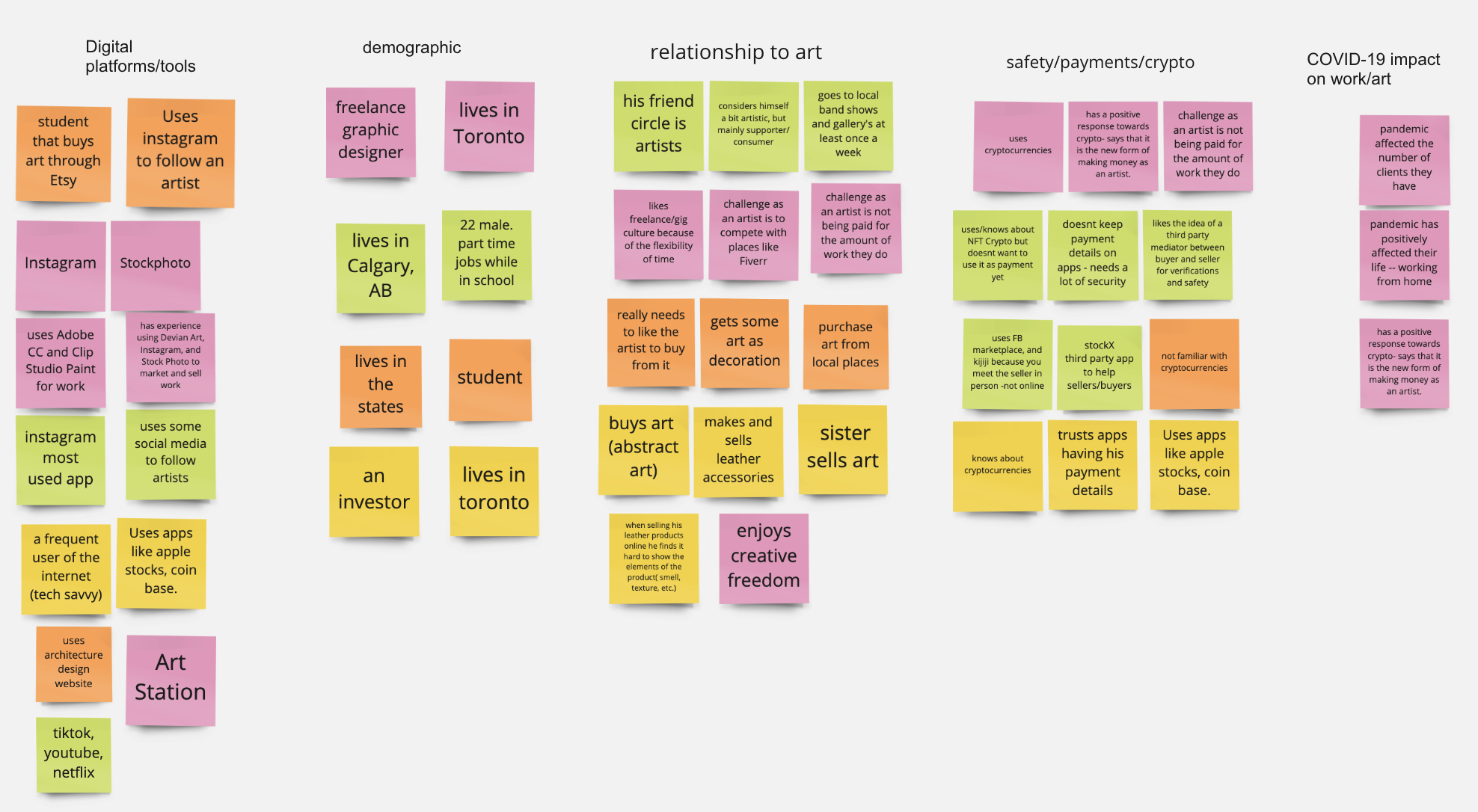
Affinity diagram with the user interview notes
After analyzing our Google survey insights and user interview insights through clustering, affinity mapping and empathy mapping, our team has created 3 main themes:
Accessibility to work opportunities
Pandemic has affected the art scene and gig economy
Copyright issues
Users don’t trust payment on apps that need verification
Safety issues with payment process
Promoting oneself as an artist
Using platforms and tools like Instagram, Etsy, TikTok, and YouTube to promote one’s work
Audience growth to attract more clients or expand client base
Problem Statement
Our group’s mobile app is designed to cater to the artist-entrepreneur to increase their network, exposure, and recognition within the community while simultaneously monetizing their work online.
Ideation
“I Like, I Wish, What If” method and Prioritization Matrix
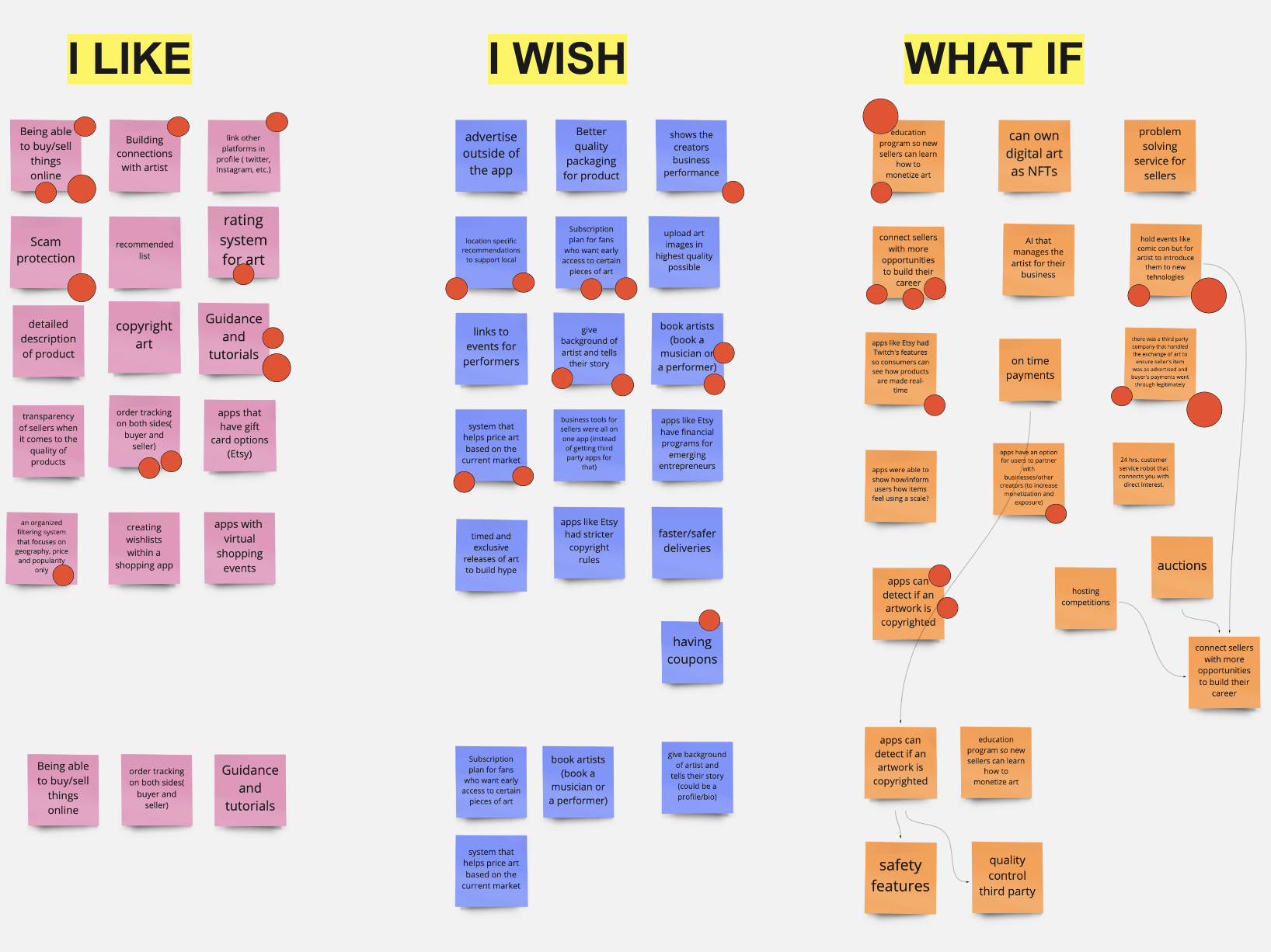
After synthesizing our user interview insights, our team used an “I Like, I Wish, What If” brainstorming method to visualize our ideas when tackling our user’s problem.
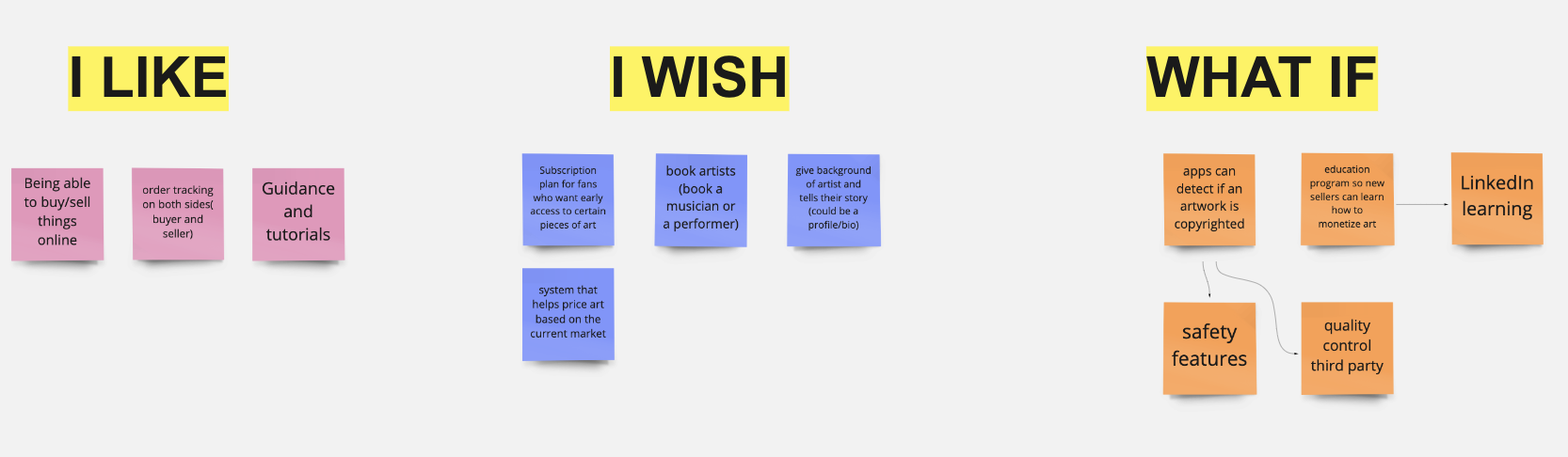
Our team voted on the post-its that we thought stood out and moved them to a separate board.
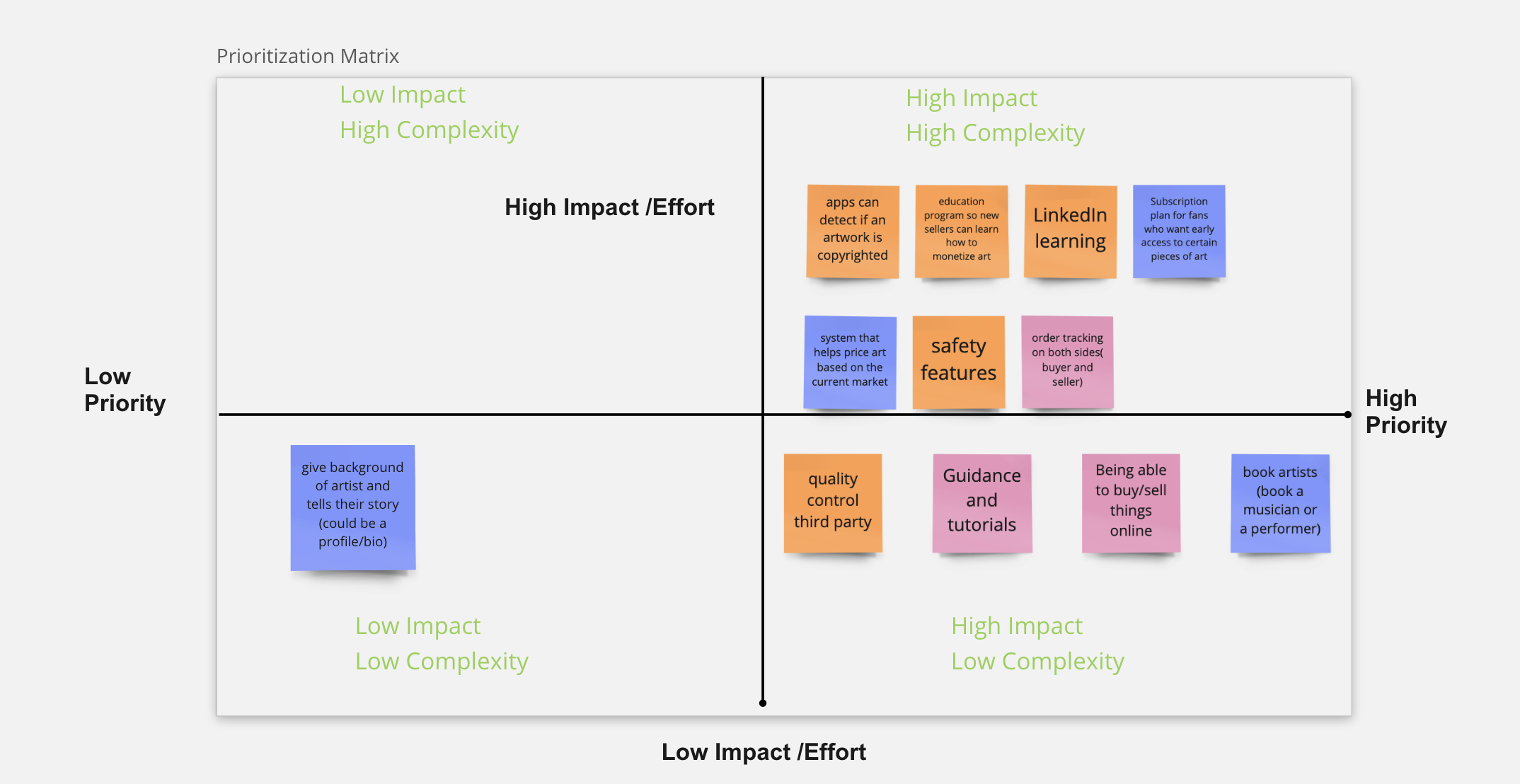
To ensure we were tackling the user problem efficiently, we prioritized all the features we wanted to introduce using the Prioritization Matrix.
Prototyping
Low fidelity wireframes
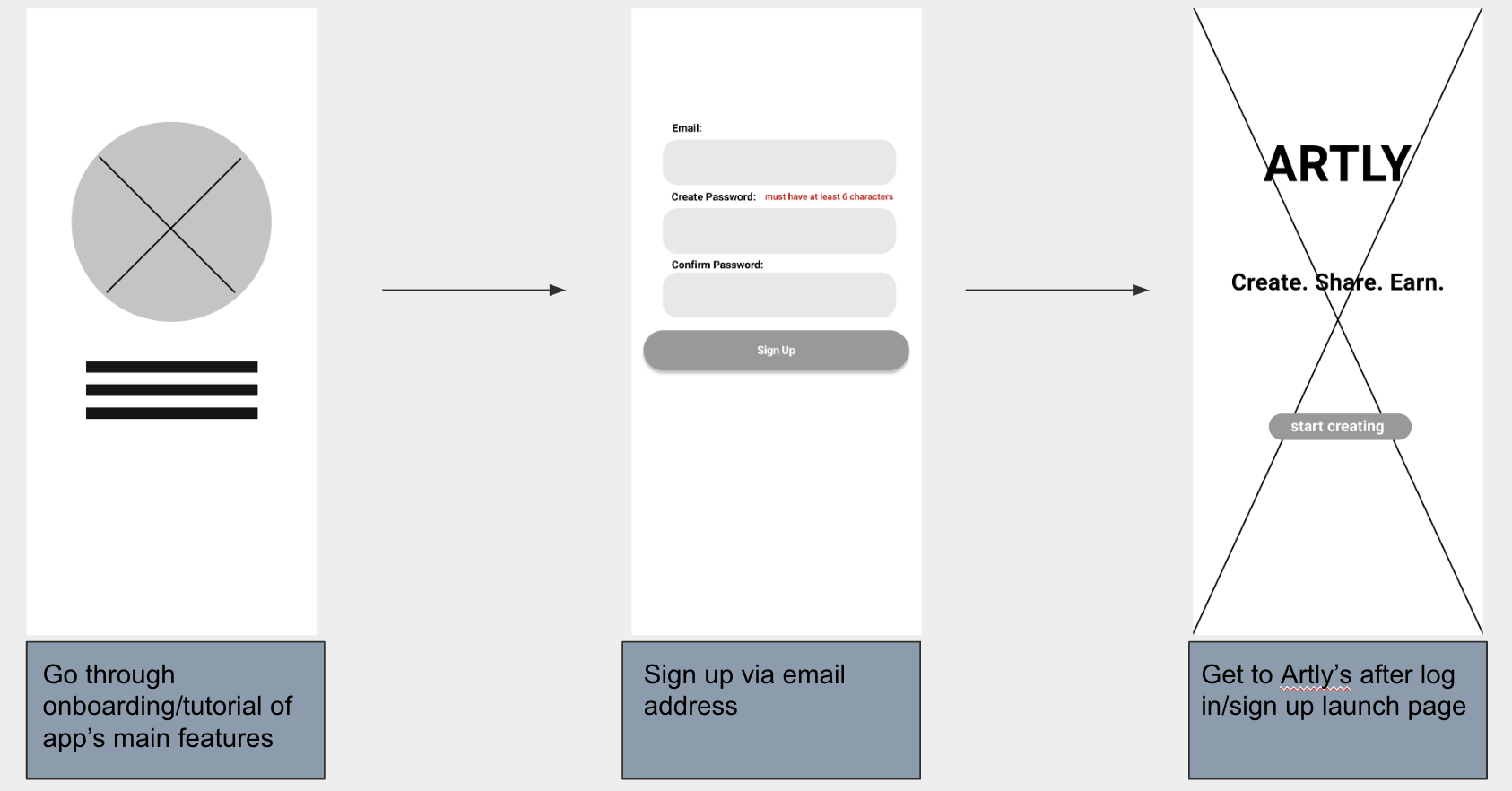
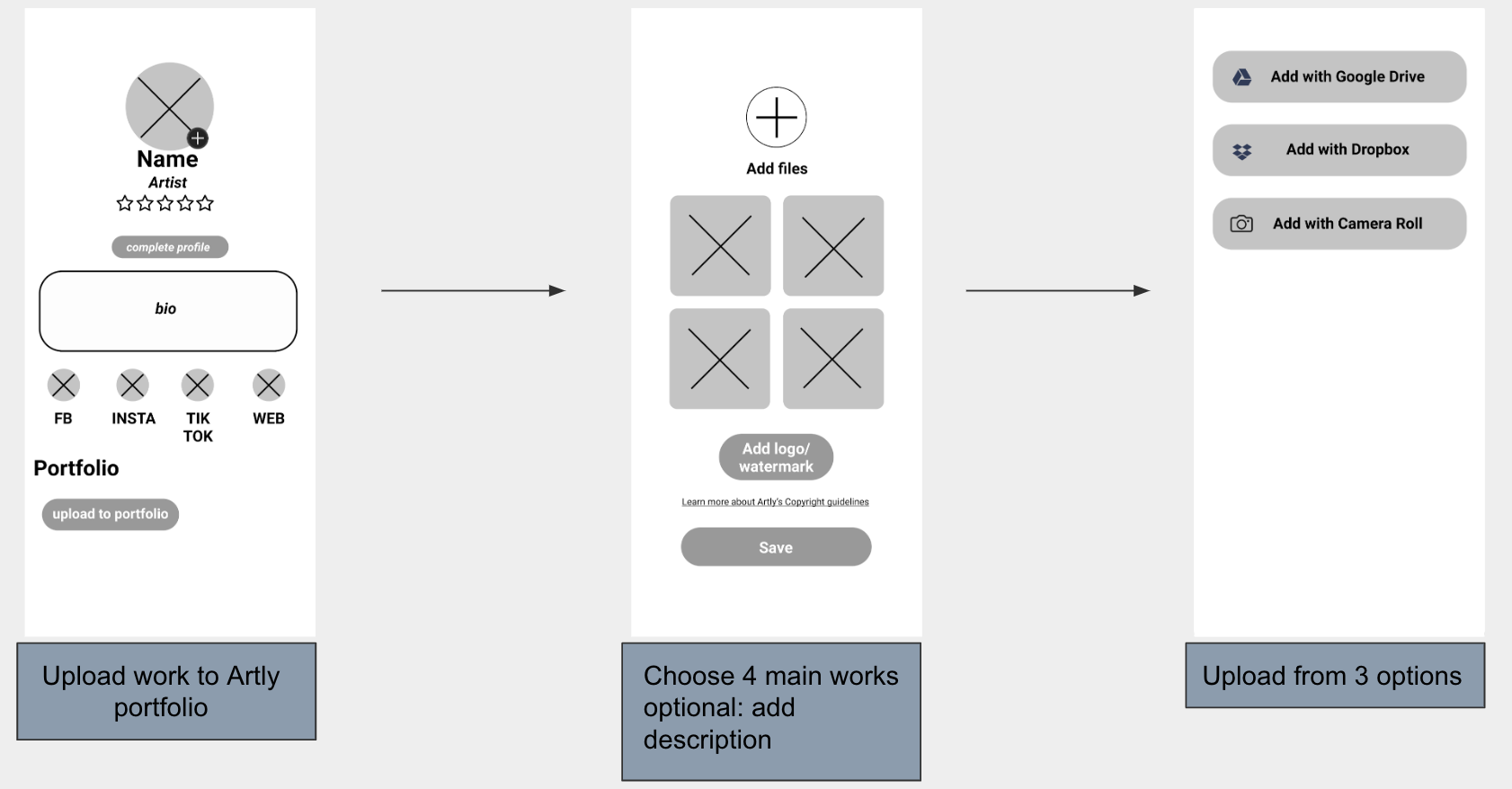
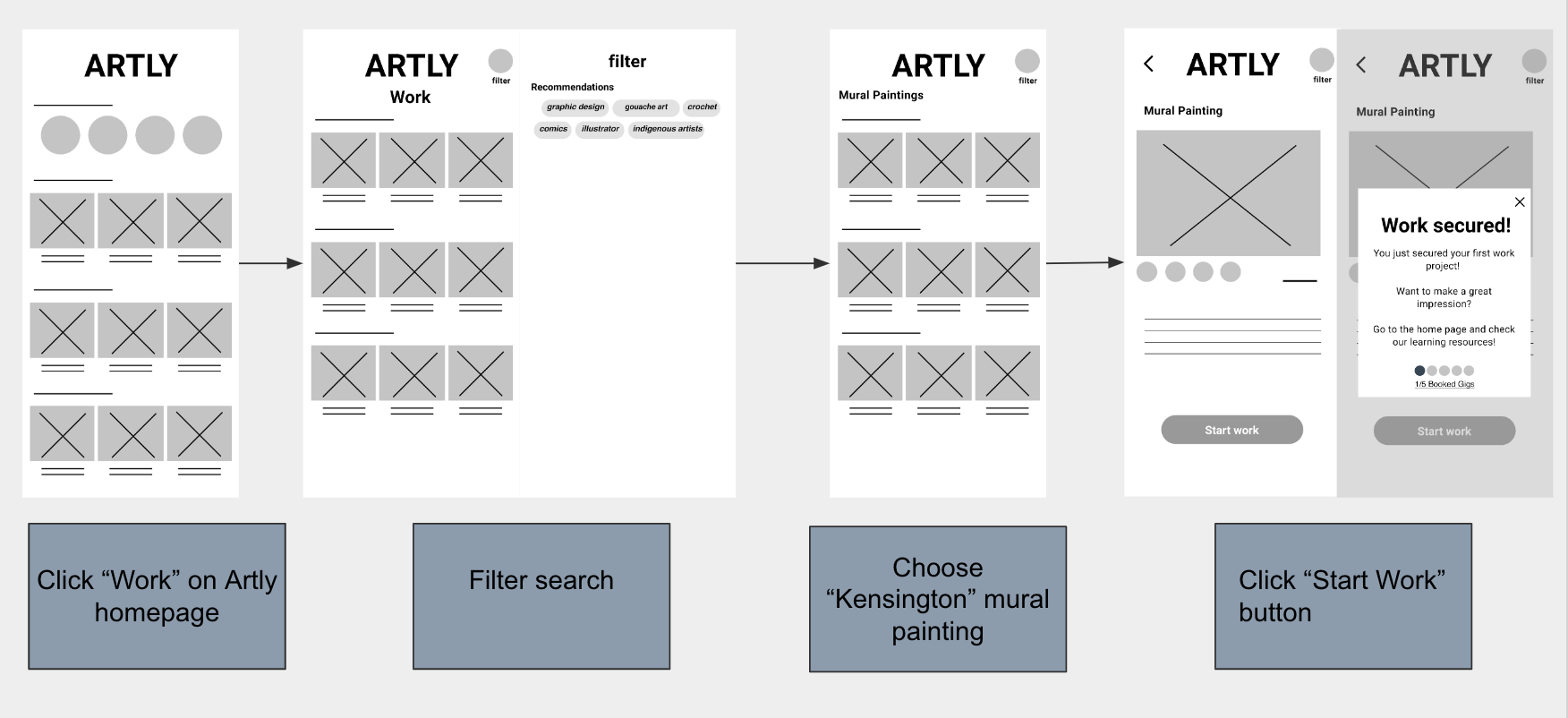
Using our competitor analysis, we created a user flow that reflects 3 major tasks: sign up, uploading work to profile portfolio, and securing work. These low-fidelity wireframes show how we prioritized human-centered design which meant cutting or removing unnecessary steps in the task flow to create a seamless user journey. Having said that, when creating the low-fidelity prototype, we focused on navigation, the simplicity and accessibility of the app and fulfilling the app’s main purpose, which is to secure work.
User Flow: Sign up
User Flow: Upload Work
User Flow: Securing Work
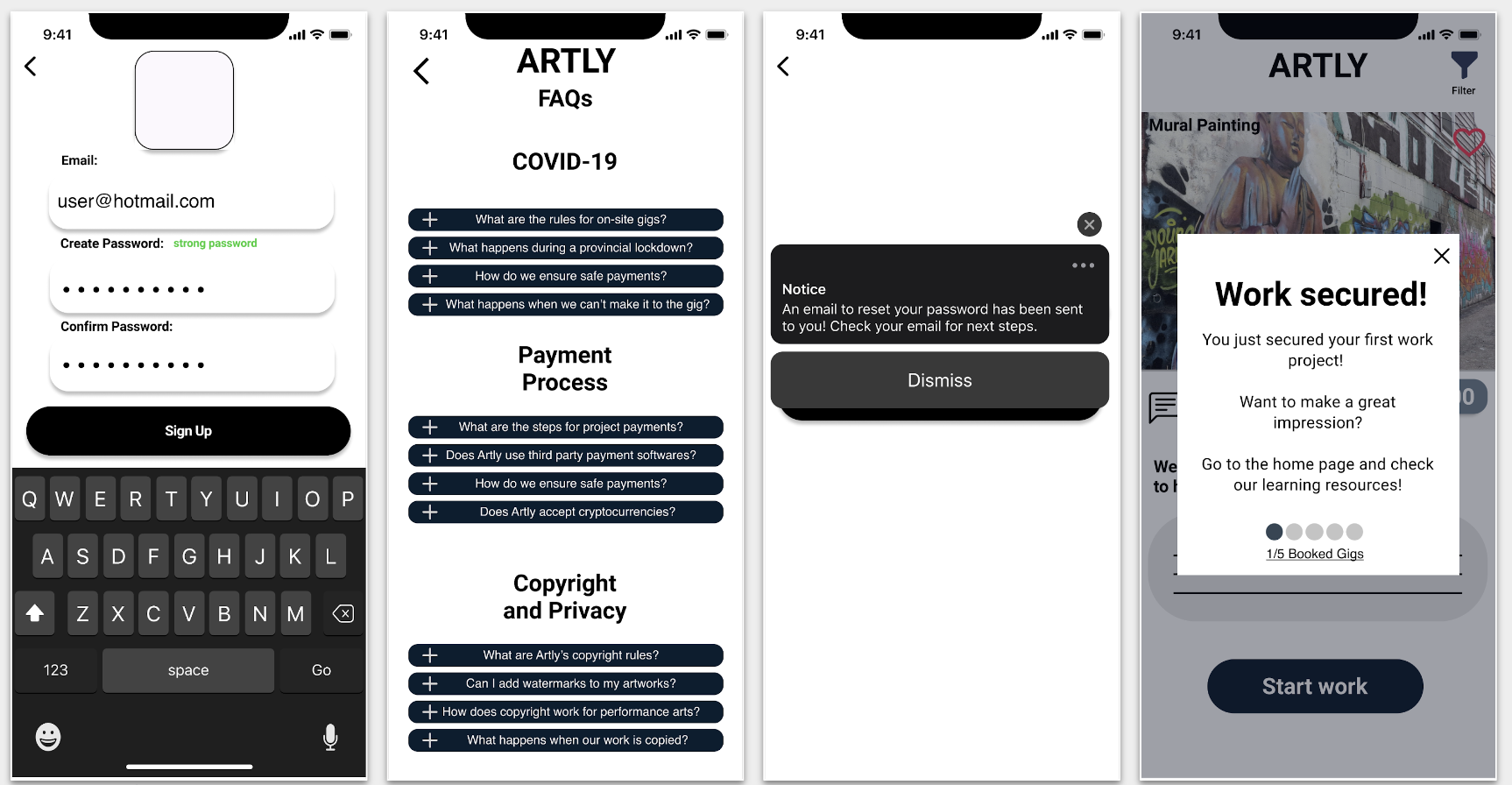
Our team wanted to focus on simple plain language in microcopy and copy, visual-textual hierarchy, chunking of similar content sets, a clear navigation, and a minimalist and cohesive aesthetic design.
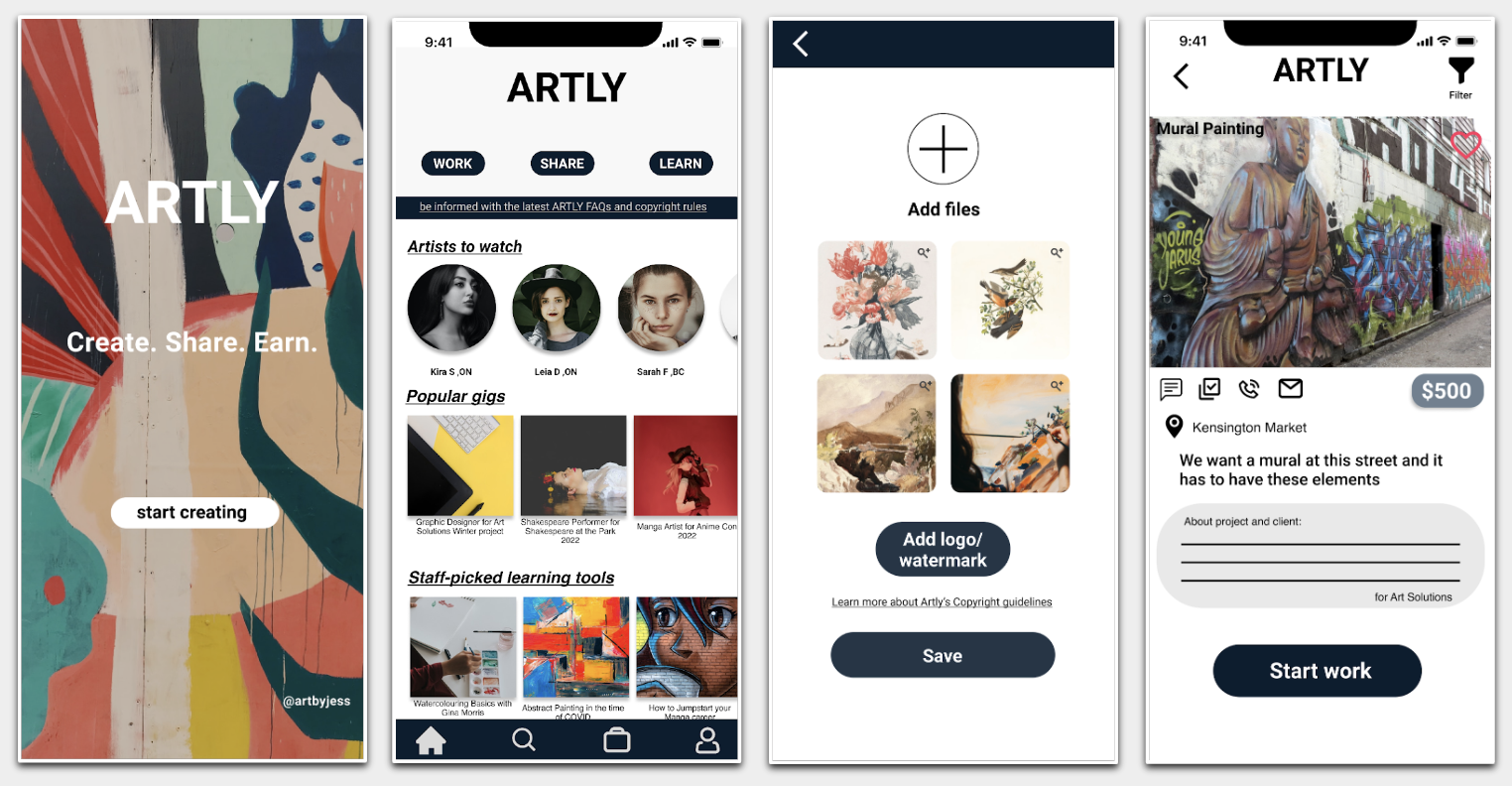
Users can use the filter system to narrow search and choose their chosen work. On the work page, you will find the project payment and the client’s contact information clearly accessible: this achieves transparency and accountability within the app.
Once they secure the work, they are notified to ensure that their action went through. Through the microcopy, we show the user how many work projects they’ve secured, ensuring a safe and healthy working environment within the app.
To view the high fidelity prototype, select the link: Artly App
Testing
We tested our high fidelity to validate our design decisions. We asked our users to accomplish 3 tasks:
Create an Artly account
Upload your work to your profile
Book a gig
Our benchmarks for success were:
Completion of task
Did the user complete the task independently?
Intuitiveness of sign up process
Did the user go through the sign up process successfully?
Discoverability of content
Did the user find the gig and book it successfully?
User Test Results & Quotes
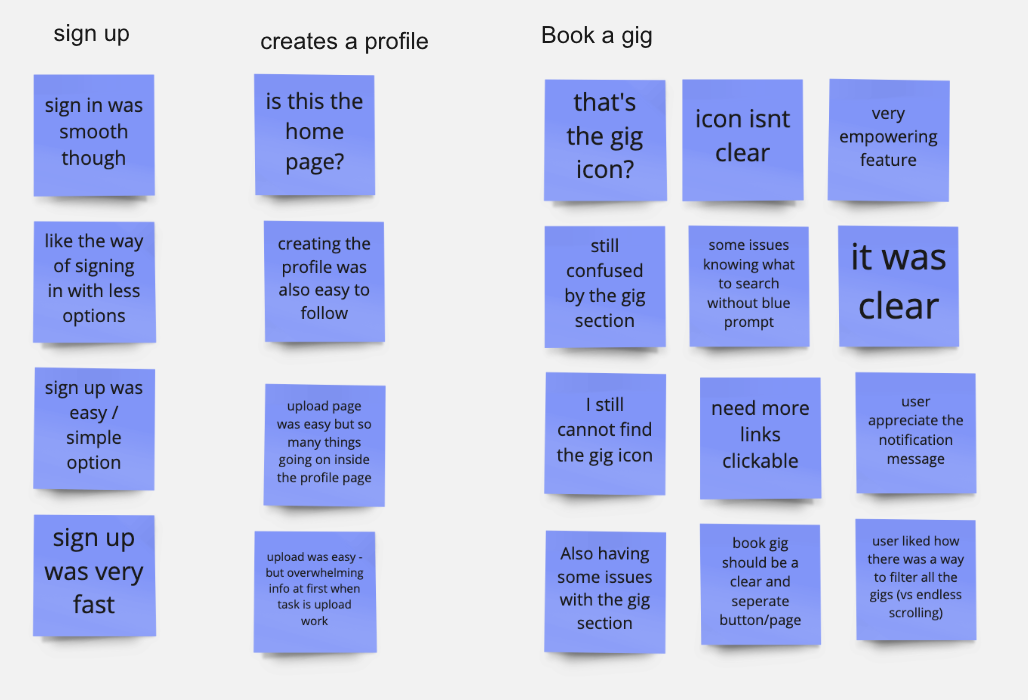
To ensure we were meeting our project deadline, we conducted 2 batches of rapid user testing within a 3-4 day turnaround.
Batch 1
Batch 2
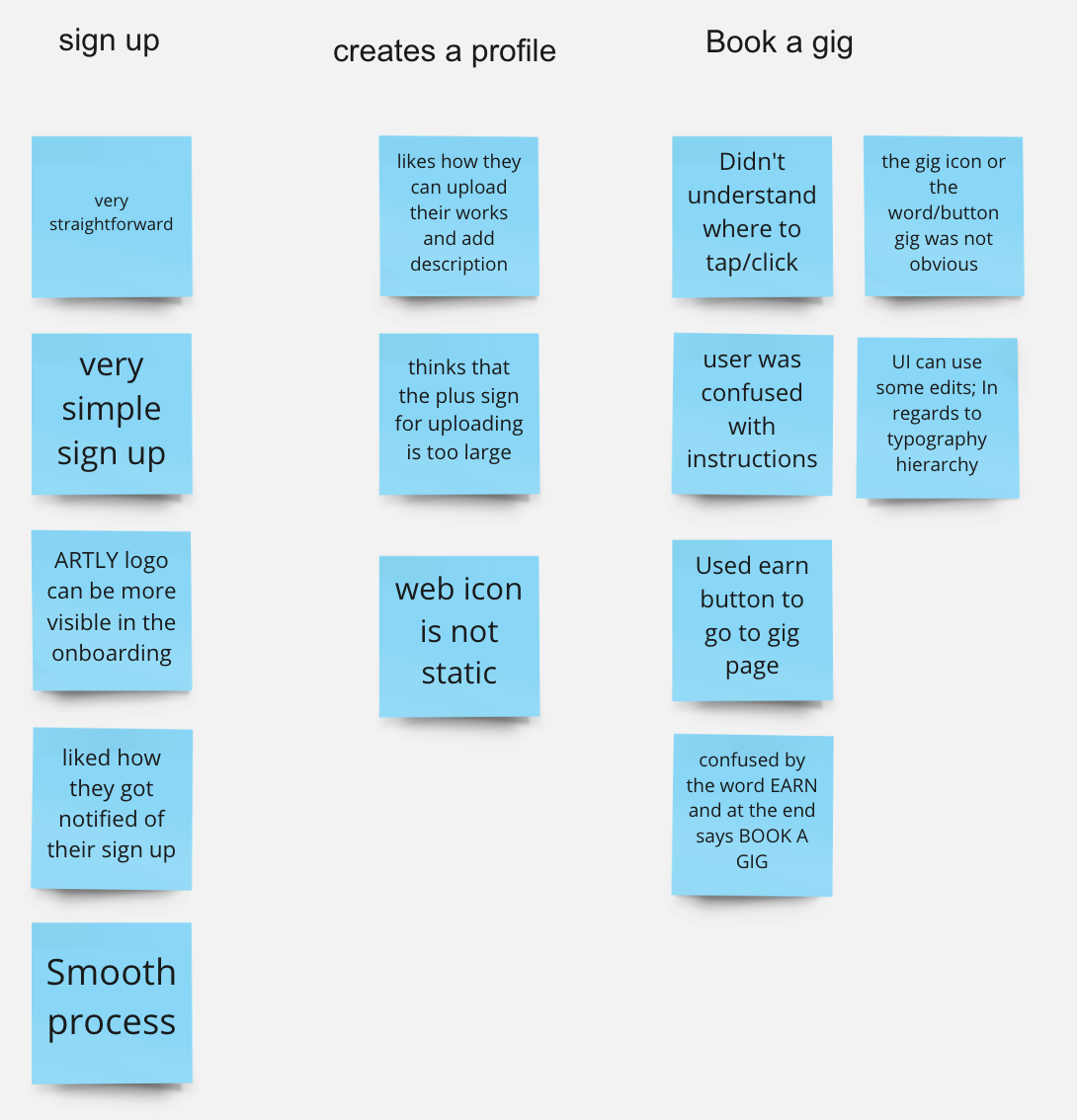
A total of 2 users participated in our 2nd batch of rapid user testing
Combining the data of both user tests, here are the results:
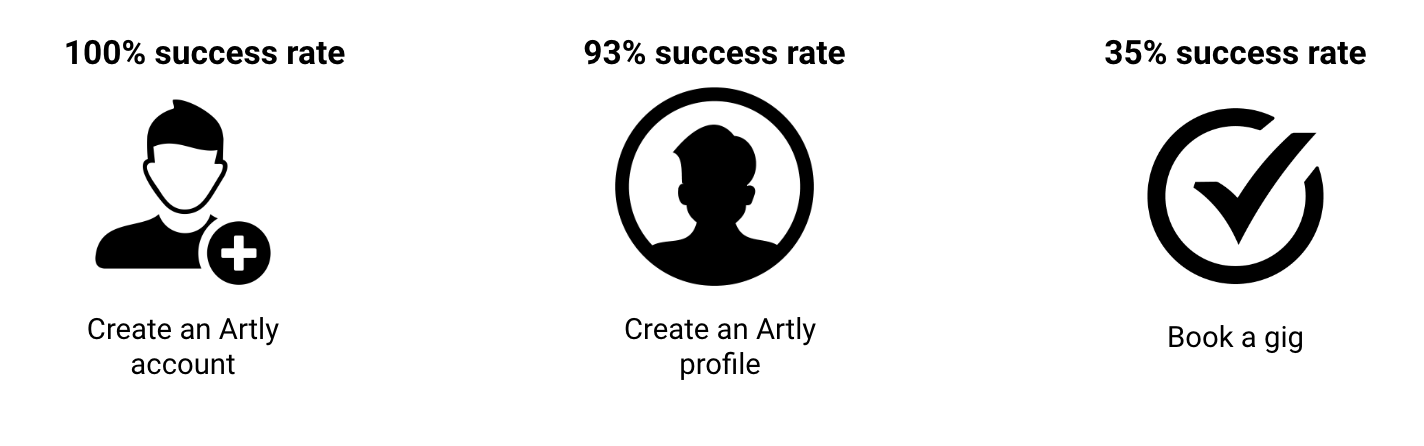
A total of 7 users participated in our rapid user tests
Learnings and final thoughts
Spend less time making the design perfect.
Our team fell into the trap of creating a very well-designed product, which gave us little time to conduct multiple user tests. Our learning lesson is to design usable prototypes that would give us room to iterate after every batch of user tests.
Conduct more user tests to validate design and content decisions
While we were making the best recommendations we could make given the timeline, conducting more user tests would have given us more insight on how to improve the “Book a gig” user flow. More user tests would give us an opportunity to see our product in other angles since we were working so close to it.
Group huddles are the best time to discuss roadblocks and task delegation
It took our team a while to get to know each other’s strengths and passions. It would have made task delegation more efficient if we spent our first few meetings getting to know each other. However, since we had such a limited timeline, we had to delve into work right away.
References:
https://financialpost.com/fp-work/the-pandemic-has-killed-the-old-hustle-culture-and-created-a-new-one-working-for-me
https://financialpost.com/personal-finance/business-essentials/amid-the-pandemic-canadians-have-launched-lucrative-side-hustles